In the '90s when I was active in parallel computing (compilers, algorithms, architectures) I had the perception that the number of parallel computing publications was multiplying to fill the market, and the growth had little to do with the number of quality papers produced in the field. Maybe this was necessary for the increasing numbers of researchers seeking tenure, but I think it hurt the quality of research in the field.
It was hard to tell which tail was wagging what, but researchers "needed" more publication venues, and libraries and researchers "needed" to subscribe to more journals.
August 5 NPR's Science Friday, there was a pair of guests talking about retractions in science journals. An interesting comment one of them made was that with more publication venues, especially with the growth of online publications, the number of items to be reviewed is growing faster than the number of reviewers. This must impact quality in a negative fashion.
Saturday, August 6, 2011


Friday, August 5, 2011
Skydrive/Windows Live or Google?
For the past month or so I've been using Microsoft's Skydrive to save files online for transfer among systems and off-site backup. I have a free gigabyte there. I've also been occasionally using Google Documents for this purpose. In each case, what I transfer is an encrypted compressed tarball, and I saw little difference in terms of performance or convenience.
Today I've decided to stop using Skydrive--it's too unreliable. Two of the last three times I've tried an upload (using Chrome from an Ubuntu box) the transfer to Skydrive has stalled. Each time, when giving it extra time, I've opened a tab and Windows Live informs me that if I leave the page the upload will be canceled. WTF? I was leaving that tab open and going somewhere else.
Until yesterday I would have said I like Skydrive, and that it's nowhere near as clunky as Outlook Live, which is very retro, and very limited in what it allows one to do. Now, I think I can say Microsoft online services are to be avoided.
Do these work better with IE on a Windows machine? Probably, but that defeats the purpose of a web-based service. Why might they work better with IE/Windows? Possibly ActiveX, and intrusive access to the PC.
Stupid Chrome Tricks
I'm using Chrome 14.0.835.15 dev on Ubuntu 10.04 LTS and I viewed a web page today, the bottom left of which looked like this:

Chrome wasn't rendering the ñ in enseñar correctly. However, I took this screen shot with the mouse pointer hovering over the link to enseñar.jpg, and at the bottom, it was rendering the word correctly. So Chrome halfway knew what encoding was in use. I went to Wrench|Tools|Encoding, and it claimed a UTF-8 encoding. Odd, this word should be rendered correctly with that encoding. I changed the encoding to ISO 8859-15, which was no better. Then I changed it back to UTF-8 since as default encodings go, that seems a good choice. Voila! The page was rendered correctly.
Apparently Chrome only said it was using UTF-8 initially, but after changing away from UTF-8 and then back, it suddenly really was using UTF-8.
Firefox 3.6.18 on the same system worked fine.
Another amusing thing is that Chrome on a Windows 7 system I occasionally use, when rendering the same page, says the original is in Afrikaans, and offers to translate it to English. Does Spanish look that much like Afrikaans?
Wednesday, July 27, 2011
Any Pluses for Plus? Minuses?
I've been on Google Plus for a few weeks now, and I don't see it as ever being worthwhile. Of course, I still don't see any reason to be on Facebook or Twitter. They all primarily waste time.
I'm not on the verge of deleting my Plus account, but I don't see any good reason not to.
I'm not on the verge of deleting my Plus account, but I don't see any good reason not to.
Wednesday, July 20, 2011
Zombies, Firefox, Chrome, and all That
I've been noticing a lot of defunct or zombie evince processes lately and decided to take a couple minutes figuring out what's going on. In the Linux world, evince is a good PDF reader, certainly better than the one freely-available from Adobe. The problem isn't with evince: zombies cannot be held accountable.
All the zombies I had on my system this morning had one of two parent process IDs, that of Firefox (3.6.18) or that of Chrome (13.0.782.56 beta). When a process forks a child, it is supposed to wait() for the child. This can be done asynchronously, so it's little inconvenience for the parent process, and not much for the programmer of the parent process, if said programmer knows what he is doing. The child process, evince in my case, hangs around the process table as a zombie until the parent issues a wait(). This allows a parent process to keep track of the status of its children. Once the parent checks on the child, the child can go away.
Firefox and Chrome are apparently not checking on their children.
Saturday, July 16, 2011
State Farm Encourages Living Dangerously
State Farm is another company that is trying to get customers to ignore TLS (or SSL for my fellow old-timers) by encouraging customers to log in from an apparently insecure page:

The form action for password submission is https://online.statefarm.com/apps/sessionmgmt/LoginService.asp? and that very well may be secure, but the fact remains that they are training their users to submit insecurely.

The form action for password submission is https://online.statefarm.com/apps/sessionmgmt/LoginService.asp? and that very well may be secure, but the fact remains that they are training their users to submit insecurely.
Cell Phone Risks
Last month I posted a pointer to Michael Blastland's recent column on statistics regarding cell phone usage and cancer. Yesterday, XKCD also had a thoughtful treatment of cell phone risks:

Really, it doesn't seem so surprising to think that cancer may cause cell phones.
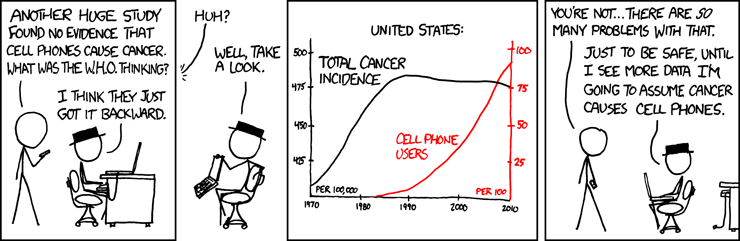
Really, it doesn't seem so surprising to think that cancer may cause cell phones.
OCR in Linux: First Impression
Tonight I was cleaning up and found a couple C programs from 1987. These were on paper, and I've been scanning and then recycling paper lately, and considered doing that here. I didn't want to take the time to type the code, though the programs were short. They were interesting enough that I might want to play with them in the future--one logs a Unix user out, killing all his processes, and the other returns the file name part of a path (dropping the path string before and the file extension). Okay, I'm not sure why that's interesting.
Besides, how many sheets of paper do you have laying around with 1987 dates marked "**** HONEYWELL FEDERAL SYSTEMS INC. CONFIDENTIAL and PROPRIETARY ****"? This dates to when I was on the SCOMP team, though has nothing SCOMP-related or even remotely confidential or proprietary. What was SCOMP? See http://en.wikipedia.org/wiki/Multilevel_security
So I scanned the code with xsane and noticed, as I had before, the option to save as text. As before, it didn't work, but this time I paid attention to the error message, gocr not found. So I googled and then install gocr (see http://jocr.sourceforge.net/) .
gocr does a respectable job, but not great. However, it's better than typing from scratch. Here are some lines from the scanned text:
- l2 jnclude stdio.h>
l3 include <signal.h>
l4
15 #define ALL_USEn_PROCS -l
l6
l7 void main()
18
l9 int kill();
20 jnt process_id;
21 int signal;
22
23 process id = ALL USR PROCS;
24 signa! =- SIGKTL ; -
25 void rintf(''\nkil1ing all rocesses...\n'');
26 void ill(prOcess_id, signa );
So it's missing underscores, curly brackets, and various other things. It looks like it added line numbers, but that's from the paper listing. Not great, but it beats typing that code from scratch, I guess. There may be some options that help it do a better job, so if this becomes important I'll have a look.
Thursday, June 30, 2011
How Many Things can Credo Do Wrong in One Billing Cycle Without Actually Phishing?
My latest cell phone bill is here. Yippee. But these folks did so many things wrong that I think I just have to say something. If I call them, they won't listen (actually, Credo might), so I'll write it up here where they almost certainly won't listen.
First, this is from the e-mail informing me that my bill is ready:
 Nothing strange here, except when I click on the "sign in" link (something to be done only with care), it didn't take me to Credo Mobile:

Note the URL. Who the heck is credobilling.com? I know who it sounds like, and I strongly suspect it's really Credo, but they think it's a good idea for me to click on a link that takes me to a web site I have never before seen, and then provide my login credentials? Credo is training users to fall for phishing attacks.
Not comfortable with that, I type the correct address into my browser, credomobile.com. This is the page I get:

Note the Member Sign-In box at the lower right, and also note that there is no indication in the address bar of HTTPS in use. This amateur behavior is not new to Credo. At least one other outfit that I do online transactions with does this same thing; I'll post on that later. Sites that try to get users to submit passwords seemingly in the clear often have a more secure failure-mode. For example, if I provide my cell number but omit the password, I get here:

That's not really my phone number. Every month I get to see the same error message, but it's worth it to see the green https:// in the address bar before proceeding.
First, this is from the e-mail informing me that my bill is ready:


Note the URL. Who the heck is credobilling.com? I know who it sounds like, and I strongly suspect it's really Credo, but they think it's a good idea for me to click on a link that takes me to a web site I have never before seen, and then provide my login credentials? Credo is training users to fall for phishing attacks.
Not comfortable with that, I type the correct address into my browser, credomobile.com. This is the page I get:

Note the Member Sign-In box at the lower right, and also note that there is no indication in the address bar of HTTPS in use. This amateur behavior is not new to Credo. At least one other outfit that I do online transactions with does this same thing; I'll post on that later. Sites that try to get users to submit passwords seemingly in the clear often have a more secure failure-mode. For example, if I provide my cell number but omit the password, I get here:

That's not really my phone number. Every month I get to see the same error message, but it's worth it to see the green https:// in the address bar before proceeding.
Wednesday, June 29, 2011
Printing to PDF, Firefox, Ubuntu
Off and on I've been irritated that Firefox print-to-file functionality defaults to postscript with the filename before the .ps extension blank. What's up with that? This is more of an issue now that I have a Kindle, and thus print to PDF much more often than to paper, so tonight I poked through about:config, shrugged, and turned to Google. I found one useful page, http://ubuntuforums.org/showpost.php?p=7890849&postcount=7, but prefer "my" way to his, simply because my filter places exactly the right configuration lines on the screen, leaving nothing to manual hunting.
1) Enter about:config.
2) Type print_to_filename in the filter bar.
3) Place exactly the same path, file name, and extension in each setting.
This is what mine now looks like:

Needless (I hope) to say, different folks will have different printers, and so my entry for an HL-2040 will be atypical and most other people will have printers not shown here.
There is no generally-useful file name, so indicating the application that generated the PDF seems a reasonable choice. IMHO, /tmp is the only reasonable directory to use so that the user's home directory isn't littered. Littering $HOME is an unfortunate tendency of Linux developers.
Friday, June 24, 2011
Mobile Phone Use May Not Cause Cancer!
Yet another good article by numerically-sensible BBC reporter Michael Blastland: http://www.bbc.co.uk/news/magazine-13886254
Monday, June 20, 2011
Sound Juicer on Ubuntu Broken
Sound Juicer now has trouble interacting with MusicBrainz to download CD names, track listings, etc. Googling led to J.P. Stacey's blog: http://www.jpstacey.info/blog/2011/06/13/sound-juicer-no-longer-retrieves-track-names-when-you-extract-audio-cds
Apparently CD Juicer has been using a deprecated feature at MusicBrainz and, as could be expected, MusicBrainz dropped support for the feature. Fortunately they still offer such a service, but CD Juicer has to be fixed to do it right.
My experience fixing this (Ubuntu 10.04) was to issue the add-apt-repository that Stacey suggests, but that gave me a 404 not found. I thought about editing config files, but decided to instead follow a link at Stacey's page to launchpad.net, or, specifically, to Philipp Wolfer: https://launchpad.net/~phw/+archive/musicbrainz
Wolfer has it right.
Wednesday, June 15, 2011
They'll be Sorry
CCBC is switching from WebCT to Blackboard 9.1. I know nothing about WebCT, but it is nearly inconceivable that it's worse than Blackboard 9.
Analogy: I've chosen an integer, 1. Then we generate a uniform discrete random integer in the range 0 to 32767. What is the probability the random integer is less than one? Approximately the same probability that an unknown course management tool is worse than Blackboard?
Analogy: I've chosen an integer, 1. Then we generate a uniform discrete random integer in the range 0 to 32767. What is the probability the random integer is less than one? Approximately the same probability that an unknown course management tool is worse than Blackboard?
Friday, June 3, 2011
Impressive Fireball at UMBC
Yesterday I was close enough to an explosion to feel the heat on
my face, 40m or so away. It was at the electrical substation just north
of the campus police station. Not very loud, but an impressive
fireball. I have to start carrying a camera.
As a result, UMBC is closed today for lack of electricity. New media reports:
my face, 40m or so away. It was at the electrical substation just north
of the campus police station. Not very loud, but an impressive
fireball. I have to start carrying a camera.
As a result, UMBC is closed today for lack of electricity. New media reports:
- Transformer Explosion Knocks Out UMBC Power, http://columbia.patch.com/articles/transformer-explosion-knocks-umbc-power
- Baltimore Sun apparently has no idea of or maybe no interest in what actually happened: http://www.baltimoresun.com/news/education/bal-umbc-power-outage-0603,0,573995.story
Google Search for MyLife.com
A sampling:
- Complaintsboard.com has many people complaining that MyLife is a scam, uses false advertising, etc. I concur.
- Just say 'no' to mylife.com, http://techpaul.wordpress.com/2009/03/06/just-say-no-to-mylifecom/ . It appears that the author gave MyLife access to his e-mail accounts, and regretted it.
- Wikipedia has an article. Highlights: lawsuits against the company for e-mail spoofing. Parent reunion.com rated F by the LA BBB.
- "Mylife.com: A new tool for bargain-seeking stalkers" at http://www.socialmeteor.com/2009/02/28/mylifecom-a-new-tool-for-bargain-seeking-stalkers/ . This article goes into some detail about how MyLife is gathering and abusing PII. Recommended.
- "MyLife.com Accused of Running 'Spam-and-Scam' Scheme" http://www.walletpop.com/2011/03/02/mylife-com-accused-of-running-spam-and-scam-scheme/ discusses a lawsuit against these slimeballs (and I'm being completely objective here) in US District Court in Oakland, CA. Links are provided.
- TechCrunch talks about the birth of MyLife as a merger of reunion.com and wink.com. This corroborates much of what's in the Wikipedia article.
Subscribe to:
Posts (Atom)